
Understanding Quality First Teaching and Reasonable Adjustments
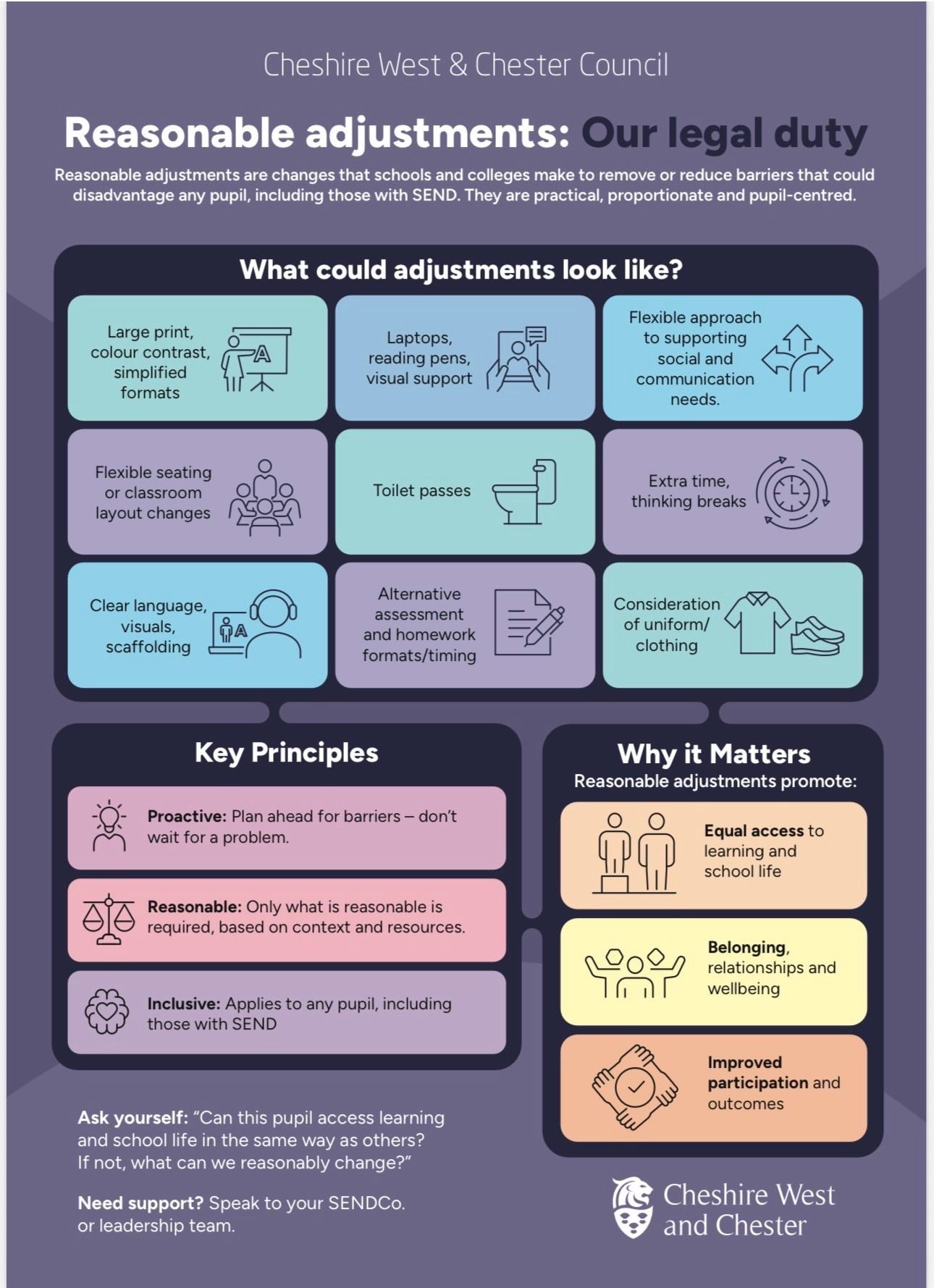
It has been wonderful to work alongside the Principal Educational Psychologist and colleagues from across education, health and care to co-produce the infographic on Reasonable Adjustments.
We know that families often tell us that the difference between Quality First Teaching (QFT) and reasonable adjustments can feel confusing. Schools sometimes feel unsure too — and this can lead to inconsistency for children and young people.
So together, we’ve set out some clear myth-busting to help everyone understand what schools must already be doing for all pupils, and what additional, individual changes some children may need.
QUALITY FIRST TEACHING (QFT)
QFT is the baseline expectation in every classroom. It is what teachers should already be doing for every pupil, including those with SEND. It is part of high-quality everyday practice.
Examples of QFT include:
• Clear instructions broken down into steps
• Visual supports used with all pupils
• Flexible seating
• Regular checking of understanding
• Scaffolding tasks
• Differentiation within lessons
REASONABLE ADJUSTMENTS
Reasonable adjustments come from a legal duty under the Equality Act 2010. Schools must remove barriers for disabled pupils by making practical, appropriate changes that allow them to access learning like everyone else.
Examples include:
• Movement breaks
• Reduced timetables
• Alternative recording methods
• Quiet spaces or time-out cards
• Sensory adaptations like ear defenders
• Adjusted behaviour expectations
REAL-LIFE SCENARIOS
Bobby has sensory differences and does not wear clothing made of certain textiles. A reasonable adjustment that has been agreed is that Bobby wears jogging trousers and a cotton t-shirt at school
instead of grey school trousers and a polo shirt. This means he can focus on learning at school instead of trying to ignore uncomfortable sensations from clothing.
Bobby is partially deaf and struggles to hear staff when they are presenting. A live stream of the teaching with auto-captions is a reasonable adjustment so that Bobby is able to read and replay parts of the lesson that he does not catch immediately. This means that Bobby can work in real time with his classmates.
Bobby experiences fatigue from attending school and finds it difficult to complete homework tasks. A reasonable adjustment is that Bobby is only expected to complete homework tasks for pre-learning of content, and staff support Bobby to use multimedia and interactive resources instead of traditional paper-based materials to minimise time spent studying outside of school.
Bobby has social communication differences and can speak over the top of other pupils. A reasonable adjustment is that staff offer Bobby paired work instead of small group work, and staff tolerate lack of turn taking. The reasonable adjustments mean that Bobby feels that his contributions are valued.
Bobby experiences anxiety in classroom settings. Reasonable adjustments are that Bobby is able to complete his work in the library when he prefers to do so and that vocal and movement-based stimming is accepted in the classroom. Bobby is therefore able to remain regulated and learn more effectively.
WHY THIS MATTERS
Reasonable adjustments are essential for equal access, belonging, wellbeing and improved participation. They help ensure every child in Cheshire West & Chester can thrive.
For more information on the PCF and what we do...
click below
Visit our 'What's On' page to join us at one of our forums or coffee drop-in events in 2026 or you can catch up on past events with our videos, presentations, information and event coverage.